Rats!
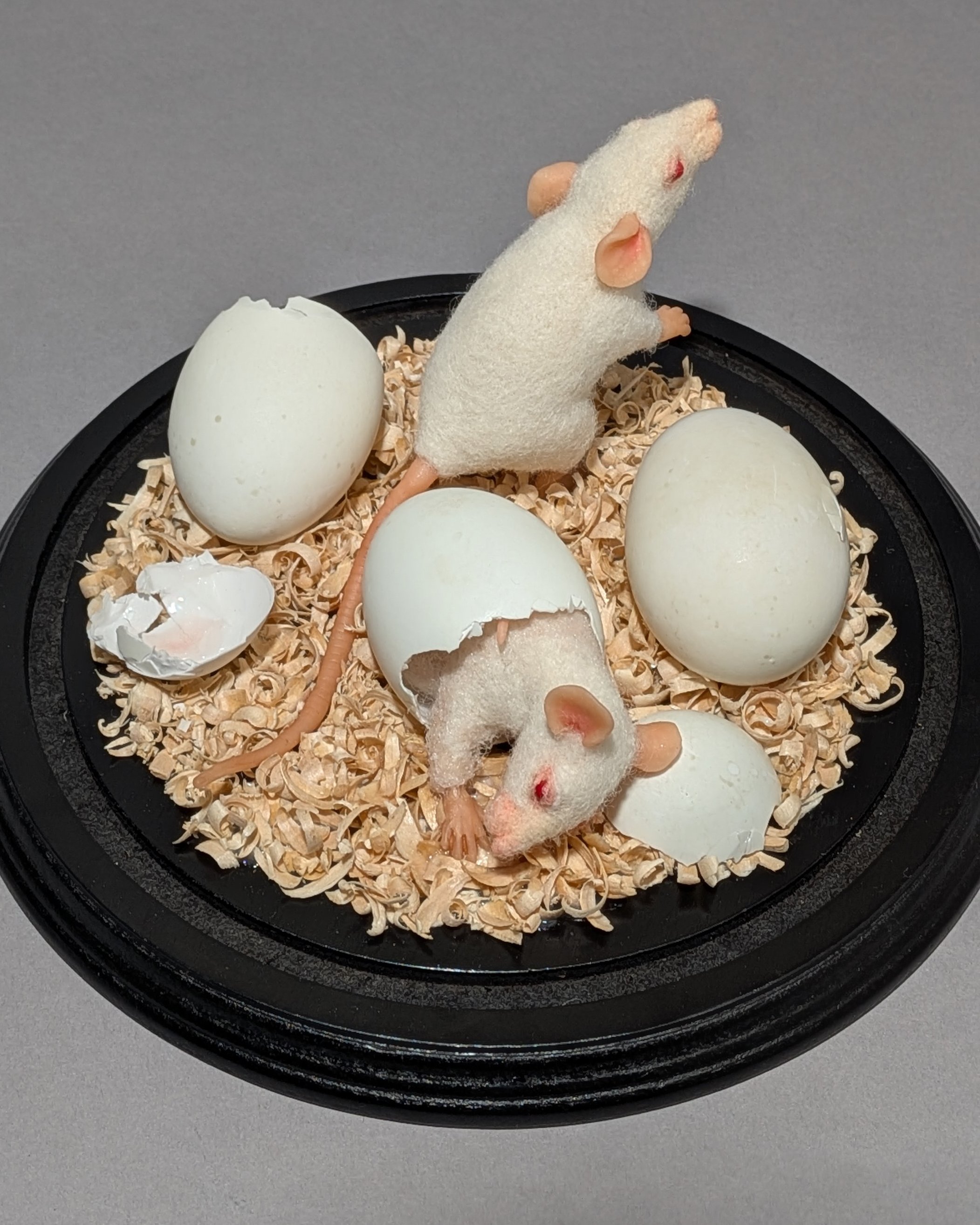
If you’re new to my work you are likely familiar with my fairly abstracted forms that suggest specimens from life but take those bits into less representational directions. That may leave you a bit confused about one of my newer pieces. Introducing Biofresh:
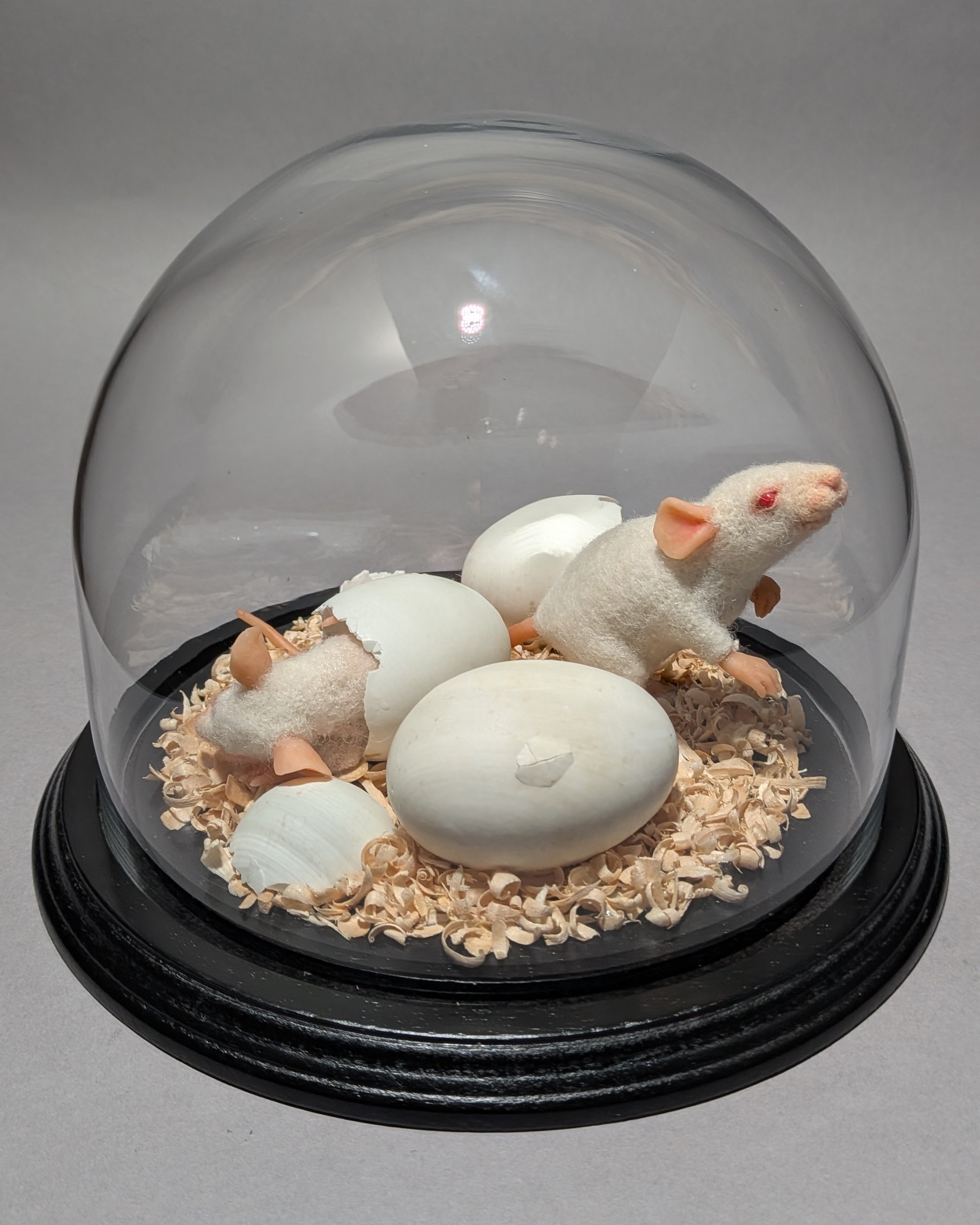
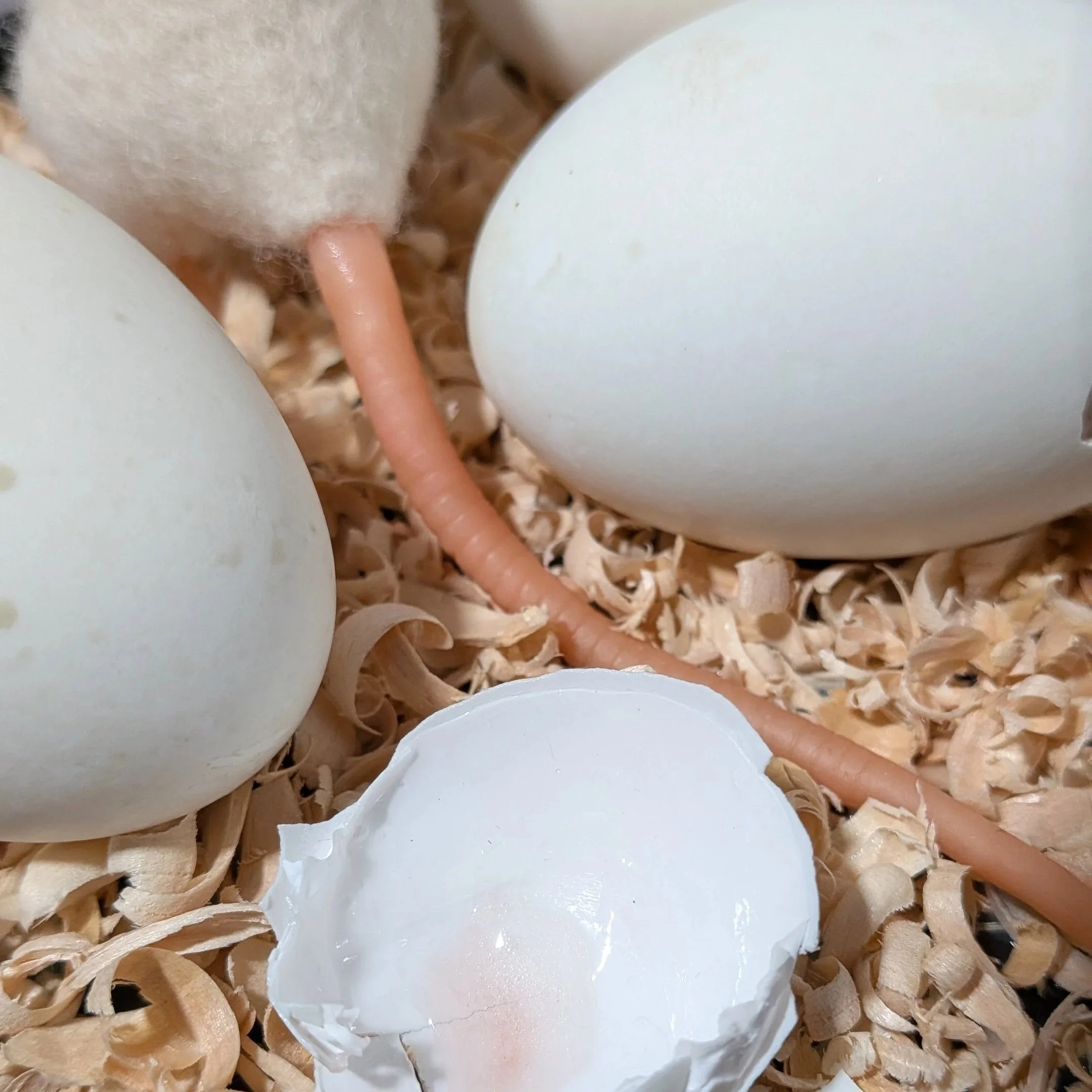
This fairly realistic scene of a trio of rats being born (out of eggs) is more of a throwback to my Overbred creatures. That body of work started early in my career as I realized that felted wool was the perfect medium to embody ideas about warm, soft creatures shaped by human will. A fascination with breeding still lingers because humans continue to exert our intentions over the other inhabitants of our planet. Sometimes this results in great advances for humankind. Sometimes it brings unforseen destruction. Often it involves a degree of both humor and pathos. That’s the angle that particularly interests me.
From imagined legless lap dogs and headless herd beasts to portraits of extreme pigeon breeds that actually exist, I use my fleshy, furry medium to point attention to the human desires that come through when we play God.
Which brings me to laboratory rats hatching out of eggs. One has fully emerged:
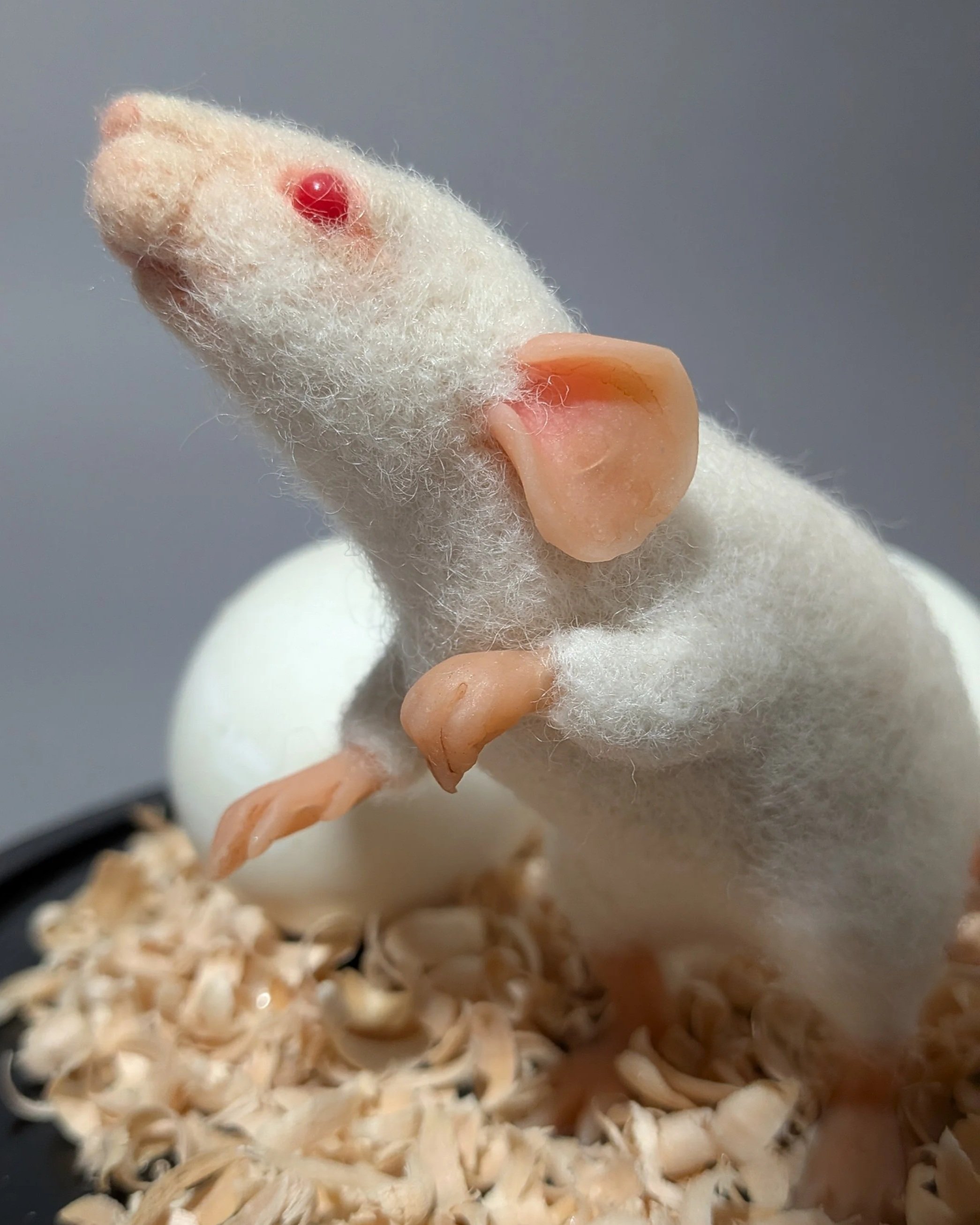
another rests after its labors:
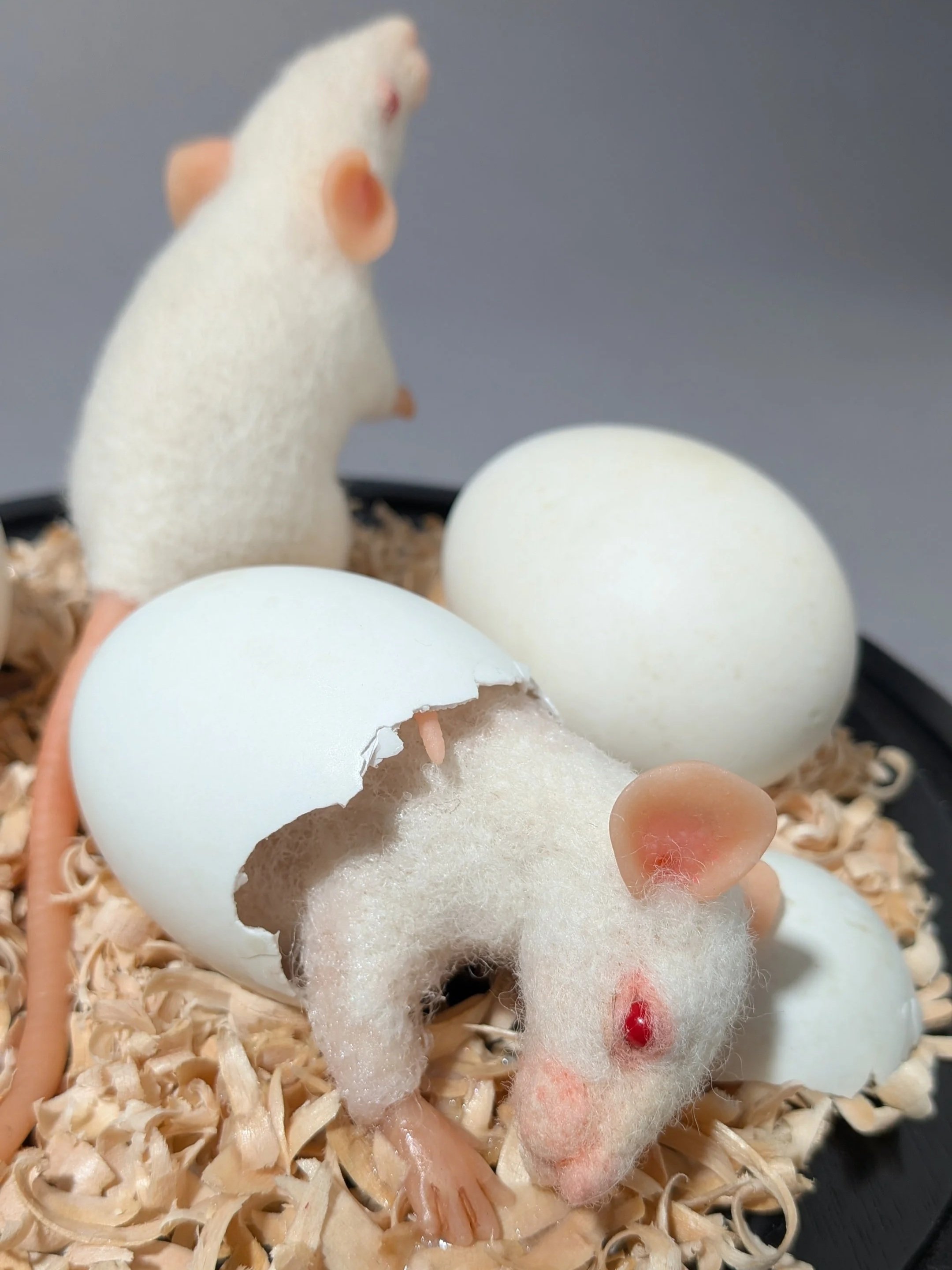
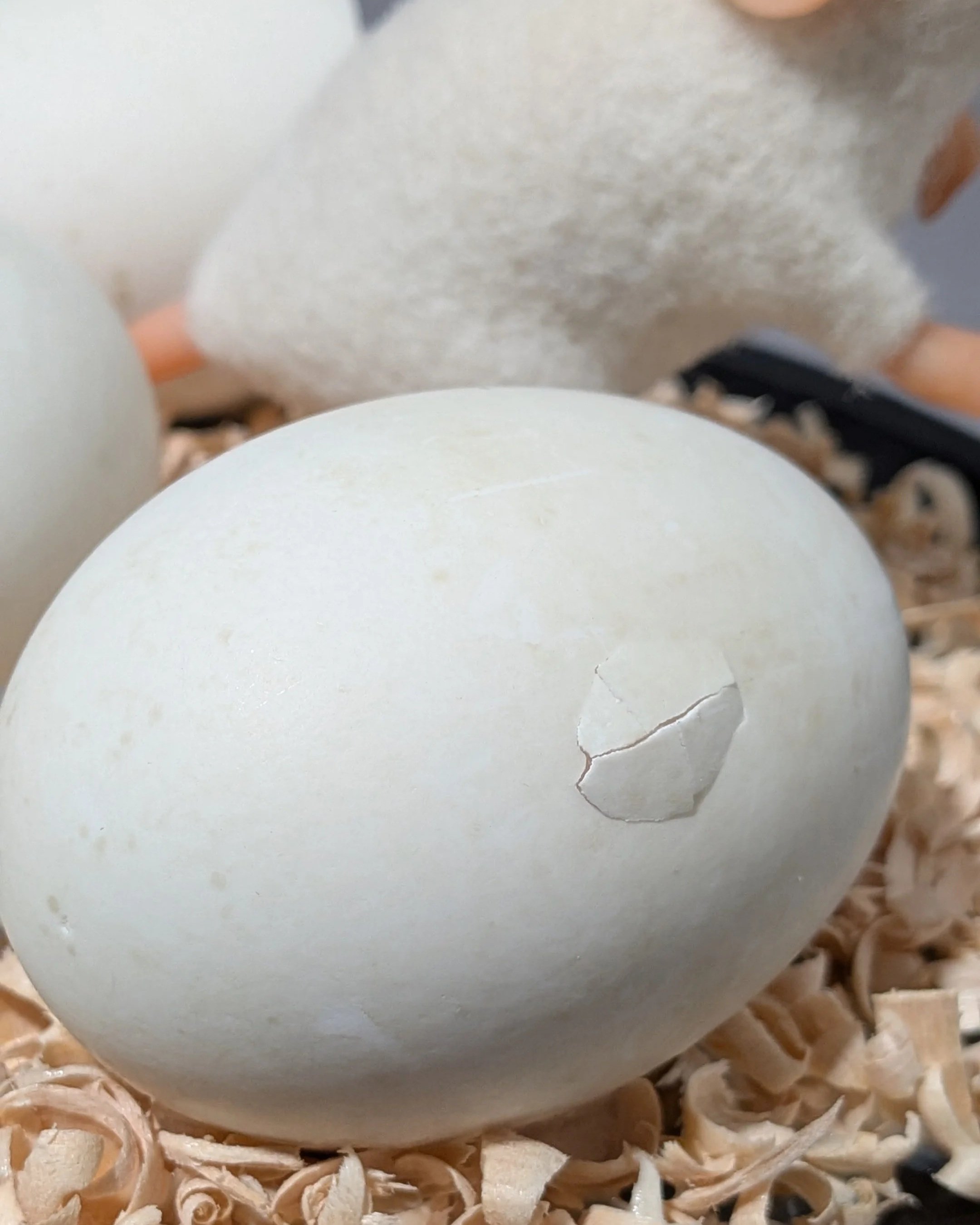
and the third is just pipping at the shell.
I hope we all know that rats do not actually hatch out of eggs; they are mammals. They are also probably one of the most uncelebrated mammals when it comes to advances in human health. Albino rats with their white fur, red beady eyes, and tiny pink hand-like paws seem distinctly different than their wild and reviled brethren. They were first used in the late 18th century for research, and were probably first sourced from rat fanciers who took advantage of coat color mutations to establish a range of coat colors. The first albino rat strain specifically bred for research was the Wistar rat, devloped in 1906 at the Wistar Institute in Philadelphia in order to make experiments more reproducible and reliable. If you want to learn more about how and why rats are used in experiments as stand-ins for humans, take a deep dive into this paper entitled The Laboratory Rat: Relating Its Age with Human’s.
I have some feelings about all this, of course. As someone who loves animals I cringe at their sacrifice on the altar of human need, especially considering what a loose term “need” could be in the history of lab rat use. But I also admire the human minds who have teased out the connections between animal physiology and behavior to design experiements that can teach us more about the way creatures live, die, and behave in the meantime.
So, why eggshells? Why make fake science?
I think there’s a growing disconnect between humankind and the natural systems of animal (and human) life and death, particularly in the technology-savvy centers of the world. We get our meat wrapped in plastic without any trace of a face. We buy our grain in a box with bright yellow flavor packets ready to go. We watch and share AI videos of believably-rendered imaginary wonders and have increasing difficulty sorting out what is real. A lack of education and experiences with the natural world leads to a lot of basic misinformation. I’d argue that the everyday overabundance of fictional visual marvels also means people are less awed by what is actually marvelous in nature. So in this piece I’ve leaned in to believable fakery to draw attention to the wonder of lab rats: where do they come from? What are their lives, to us humans? How often do we think about them?
Eggshells embody contradictions in the most basic way: they can mean life OR death. Life AND death. Life: the beginning of a new creature’s time on earth. Death: a food source for a different creature’s life. Eggshells are strong, to protect what’s inside, and also breakable, to allow what’s inside to break free. I’ve incorporated eggshells in my Adversatio body of work during Covid times to explore those oppositions in a very fraught time. It feels fraught again now. The eggshells in this piece, by the way, are duck eggs. I started out with chicken eggs, but they just weren’t quite big enough. By the time I had to carefully break the limited quantity of duck eggs I acquired I had already researched how chicks hatch (pipping at the side of the wider end, then working in a circle) and practiced with several chicken eggs.
The most direct origin of this piece was a notification from Antler & Talon Gallery in Portland, Oregon, that I was a finalist for the Susannah Kelly Art Award, a yearly way to honor the late co-founder of the gallery who died far too young. As one of twenty runners-up to the prizes given for sculpture, painting, and drawing, I was invited to create a piece focused on themes of rebirth, renewal, and the circle of life. The gallery is known for its nature-inspired art with a strong focus on technical skill with a bit of the surreal and fantasy realm thrown in.
Like many ideas for works, I can’t specifically trace the path of thoughts that led to picturing a trio of baby rats being hatched out of eggs. But I knew I wanted to make them as realistic as possible, so I turned to my friend Judith Klausner, a sculptor who often uses polymer clay to stunning effect in her realistic sculptures, to advise. She suggested the slightly flexible and translucent Cosclay (not sponsored, just think it’s worth sharing) for ears, feet, and tails and provided excellent advice on the use of a comb for tail details. Here’s to artists sharing knowledge!
With my recent three-legged headless cow piece I dipped my toe back into the realm of narrative pseudo-realism. I have a few more up my sleeve.
“Biofresh” is named after a brand of rodent bedding marketed for laboratory use that sounds rather aspirational.
If you want to add this piece to your collection you can purchase it through the gallery here. You can also see the catalogs for the rest of the work in the show including the grand prize winner catalogs:
The Ribbon Catalog
Painting Category: Lauren Richelieu
Drawing Category: Ricardo Ales
Sculpture Category: Austyn Taylor
See the exhibitions at Antler and Talon Gallery from September 24 - October 30th.
Opening reception: Thursday, September 24, 6 - 9pm
Hours are Friday 3-7pm, Saturday 2-6pm, and Sunday 1-3pm